Curriculum
Social entrepreneurship sits between the case study and the balance sheet. Our courses ask students to hold both at once: a clear-eyed understanding of a problem, and the discipline to build something durable enough to help address it.
SEID develops and delivers core courses that introduce students to complex social and environmental systems, analytical frameworks for understanding these problems, and tools for designing enterprise and policy responses.
Students seeking rigorous foundations and practical tools. Faculty contributing modules, cases, and applied learning linkages. Practitioners and alumni supporting teaching, cases, data access, and collaboration.
Core courses, applied modules, cases, interdisciplinary learning pathways, and capstone-aligned learning experiences.
Social Entrepreneurship
Public Policy 43 / Economics 5.1 · Fall Term, 3B
What if the power of markets could help address society’s biggest challenges? This is the course where you take that question apart.
Instructors
Katherine Milligan & Curt Welling
Term
Fall Term, 3B
Prerequisites
Open to all majors. No prerequisites required.
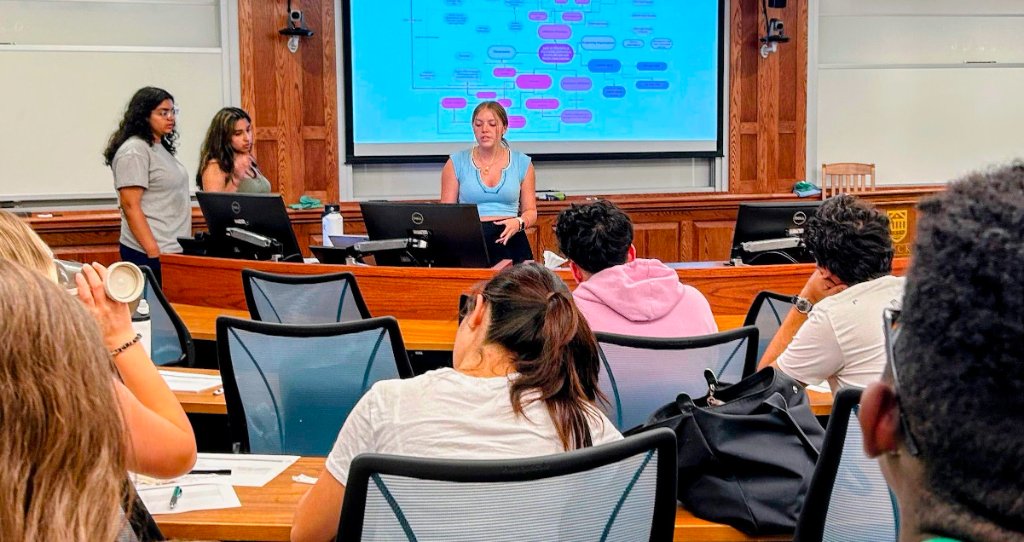
Public Policy 43 introduces students to the theory and practice of social entrepreneurship and social innovation. Social entrepreneurship can be understood as the process of creating positive social or environmental change through innovative, pragmatic, and often market-based solutions to complex problems. Many of these challenges exist within systems shaped by public policy, institutional constraints, economic incentives, and unequal access to resources.
The course examines the emergence of social entrepreneurship as a field operating at the intersection of the public, private, and nonprofit sectors. Students will engage with foundational concepts, analytical frameworks, and real-world case studies to understand how mission-driven organizations seek to address problems such as poverty, inequality, environmental degradation, healthcare access, and unemployment. Throughout the course, social enterprise will be situated within broader debates about market failure, public policy failure, systems change, accountability, and the limits of institutional reform.
In addition to introducing the core organizational models and strategies used by social enterprises, the course explores the practical realities of designing, financing, scaling, and evaluating social innovations. Students will critically examine the promises and limitations of market-based approaches to social change and assess how social enterprises interact with, complement, or challenge traditional government and nonprofit responses.
Format: Seminar with practitioner guest speakers, case discussions, and team-based applied projects.
This course serves as a foundational entry point for the interdisciplinary pathway in social entrepreneurship and innovation currently in development at SEID.
Course offerings, terms, and instructors are subject to faculty approval and the published Dartmouth timetable. Check the ORC and the timetable of class meetings for the current term.
Skills that travel
Whatever students go on to do, in policy, a nonprofit, government, business, research, or a venture of their own, these are the capabilities the curriculum is built to develop.
Systems thinking
See a whole problem, its feedback loops and its history, not just the symptom in front of you.
Venture and financial fluency
Read a business model, build one, and understand how mission-driven organizations are financed.
Research and evidence
Distinguish secondary research, primary research, and lived experience, and know what each is good for.
Cross-sector fluency
Move credibly between the public, private, and nonprofit worlds, because real problems sit across all three.
Ethical judgment
Weigh trade-offs honestly when the right answer is contested and the stakes belong to someone else.
Making the case
Explain a complex problem and a proposed response to people who can act on it.
Social entrepreneurship across campus
SEID courses are one part of a wider set of offerings. If you are trying to build a coherent path across several of these, come and talk to us and we will help you plan it.
Tuck School of Business
Wicked Problems, social entrepreneurship coursework, and the Center for Business, Government and Society.
Thayer School of Engineering
Entrepreneurship and design courses, and human-centered design studio work.
Rockefeller Center
Public policy coursework, leadership programs, and SEID’s institutional home.
Dartmouth Center for Social Impact
Systems mapping, community partnerships, and the ImpACT program.
Dickey Center for International Understanding
Global health, security, and international policy programming.
Magnuson Center for Entrepreneurship
Venture-building resources and the wider entrepreneurship ecosystem.
Not sure where to start?
Start with PBPL 43. There is no prerequisite, every major is welcome, and it is the course that opens onto everything else we do.
Explore the other pillars
Co-curricular programs, faculty engagement, and experiential learning.